Implementing Iron Condors via the Interactive Brokers API
Introduction
Algorithmic options trading lies at the intersection of quantitative modeling, data-driven decision making, and automated execution systems. In modern quantitative workflows, strategies are no longer limited to single-leg options but often involve complex multi-leg structures designed to control risk and extract value from volatility and time decay. Among these, the Iron Condor has become one of the most studied and deployed because of its well-defined risk profile and its ability to generate consistent returns in stable markets.
A multi-leg strategy like the Iron Condor allows traders to express a market-neutral view by simultaneously selling option premium near the money and buying protection further out on both sides of the distribution. This creates a limited-risk, limited-reward structure that benefits from the natural erosion of time value, also known as theta decay, and from periods of reduced implied volatility. For a quant developer, automating the construction and management of such strategies introduces an additional layer of complexity that requires a solid understanding of both financial theory and execution architecture.
This article demonstrates how to connect those two worlds by implementing an automated Iron Condor strategy through the Interactive Brokers (IB) API using C++. The goal is to show how a quantitative idea can be transformed into an executable, production-grade workflow capable of building, pricing, and submitting multi-leg option combinations dynamically based on real-time market data.
The Iron Condor provides an ideal example for this integration. It involves four distinct option legs with the same expiration date, arranged to create a range-bound payoff that profits when the underlying asset remains within a predefined zone. From an engineering standpoint, managing these four contracts as a single trade requires a precise understanding of how IB models complex structures through BAG contracts and how algorithmic order types, such as Adaptive orders, can enhance execution efficiency.
The discussion progresses from financial theory to practical implementation and covers the following key topics:
- The financial logic and payoff of the Iron Condor
- The risk profile and key Greeks that define its behavior
- Programmatic implementation in C++ using the Interactive Brokers API
- Performance, robustness, and deployment considerations for automated systems
The complete and fully documented source code for the implementation is available on GitHub.
Structure Overview
An Iron Condor consists of four option legs with the same expiration date:
| Leg | Type | Action | Strike |
|---|---|---|---|
| 1 | Put | Buy | K_1 |
| 2 | Put | Sell | K_2 |
| 3 | Call | Sell | K_3 |
| 4 | Call | Buy | K_4 |
where K_1 < K_2 < K_3 < K_4
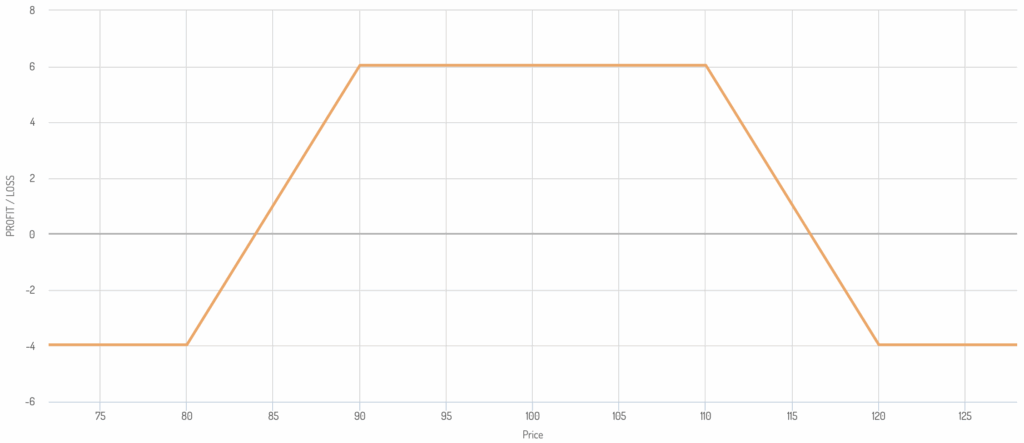
This configuration creates a range-bound strategy.
The trader earns a premium when the underlying stays between K_2 and K_3 and faces limited losses if the price moves outside the wings K_1 and K_4 .
Payoff Intuition
The Iron Condor collects option premium from the two short middle strikes while buying the outer strikes to limit tail risk.
The result is a flat profit zone around the current price and capped losses on both sides.
It is suitable for markets expected to remain stable or for volatility-selling approaches.
| Market Behavior | Effect on Condor |
|---|---|
| Price stable | Collects premium (profit) |
| Strong move up | Call spread loses value |
| Strong move down | Put spread loses value |
| Volatility decline | Increases profit |
| Volatility spike | Reduces profit |
Mathematical Formulation
Payoff Function
Let S_T be the price of the underlying at expiration.
The payoff of an Iron Condor Π(S_T) can be written as: Π(ST)=max(K_1−S_T,0)−max(K_2−S_T,0)−max(S_T−K_3,0)+max(S_T−K_4,0)
This piecewise function behaves as follows:
| Region | Condition | Payoff Behavior |
|---|---|---|
| 1 | S_T < K_1 | Constant loss (limited downside) |
| 2 | K_1 < S_T < K_2 | Rising toward breakeven |
| 3 | K_2 < S_T < K_3 | Flat maximum profit |
| 4 | K_3 < S_T < K_4 | Declining toward breakeven |
| 5 | S_T > K_4 | Constant loss again |
Profit and Breakeven Points
| Metric | Formula | Description |
|---|---|---|
| Maximum Profit | Net credit received | Earned when S_T \in [K_2, K_3] |
| Maximum Loss | Spread width − credit | Occurs outside the wings |
| Breakeven Points | K_2 + \text{Credit}, \quad K_3 – \text{Credit} | Limits of profit zone |
The payoff curve forms a trapezoid, flat in the center and capped on both sides.
Risk Profile and Greeks
Sensitivity Overview
| Greek | Interpretation | Condor Exposure |
|---|---|---|
| Delta (Δ) | Sensitivity of the option’s value to changes in the underlying price | Close to zero at initiation, which makes the Iron Condor approximately market-neutral |
| Gamma (Γ) | Rate of change of Delta with respect to the underlying price | Slightly negative, meaning the position loses Delta neutrality when the market moves quickly |
| Theta (Θ) | Time decay, representing how the position gains or loses value as expiration approaches | Positive for short Condors, since the position benefits from the erosion of option premium over time |
| Vega (ν) | Sensitivity of the option’s price to changes in implied volatility | Negative, since a drop in volatility improves profitability while an increase can reduce gains or cause losses |
Detailed Interpretation
The Iron Condor is primarily a theta-positive and vega-negative strategy.
This means it profits from the natural decay of option premiums over time and performs best when volatility remains stable or declines. The short options at the center of the structure, typically near the current price of the underlying, lose value each day as time passes. This gradual erosion of extrinsic value works in favor of the trader who sold the spread.
Time decay is strongest when the position is close to expiration, especially for options that are near the money. As the days pass, the short strikes lose value faster than the long protective wings, leading to a net profit if the underlying remains inside the profitable range. However, this accelerated decay near the end of the option’s life also increases risk, because small price moves can quickly push the underlying outside the profitable zone. This is a direct consequence of negative Gamma, which increases as expiration approaches.
The Gamma of the Iron Condor acts as a double-edged factor. At the start of the trade, Gamma is small, so price movements have little effect on Delta and the position remains relatively stable. As expiration gets closer, Gamma rises, which causes Delta to shift more rapidly when the market moves. A previously neutral position can quickly become directional if the underlying price drifts near one of the short strikes. Traders often manage this effect by reducing position size or closing the trade early when a certain profit target is reached, instead of holding the position until expiration.
Delta for the Iron Condor starts near zero, since the position is constructed symmetrically around the current price. This neutrality can change if the market trends toward one side. For example, if the price moves upward, the short call spread begins to lose value while the short put spread becomes less sensitive. As a result, the overall position becomes slightly short Delta. Similarly, if the market drops, the position turns slightly long Delta. Some traders hedge these changes by adjusting the strikes or adding a small offsetting position in the underlying asset.
Vega represents exposure to changes in implied volatility. Since an Iron Condor involves selling more premium than it buys, its net Vega is negative. The position benefits when implied volatility decreases, because the value of the short options drops faster than that of the long protective ones. On the other hand, a spike in volatility increases the cost of all options, widening the bid–ask spreads and reducing the value of the Condor. This risk is especially relevant during earnings announcements or macroeconomic events that cause sharp volatility expansion. Monitoring volatility trends is therefore essential when managing this strategy.
In practice, professional traders view the Iron Condor as a volatility and time management position rather than a pure price bet. The trade’s success depends on the balance between Theta gains and Vega losses over time. If volatility remains steady or falls, Theta accumulation dominates and the position earns a steady profit. If volatility rises sharply or the underlying makes a strong directional move, Gamma and Vega effects can overwhelm the slow Theta gains, leading to losses.
Dynamic hedging and position adjustments can help maintain balance. Traders may shift strikes outward when volatility increases, close one side of the Condor to reduce directional exposure, or hedge with futures or ETFs to control Delta. Such adjustments keep the overall portfolio aligned with the intended neutral and limited-risk profile.
Practical Insight
- Short Condors earn from time decay and falling volatility.
- The position remains roughly Delta-neutral near initiation.
- Vega risk increases near expiration when implied volatility rises.
- Dynamic hedging can mitigate directional or volatility shocks.
Interactive Brokers API Concepts
IB API Architecture
| Component | Role |
|---|---|
| Client | Your trading program (C++, Python, or Java) |
| Server | IB Gateway or TWS that connects to IBKR systems |
| Contract | Definition of a tradable instrument (e.g., AAPL 150C 20251031) |
| Order | Details of how to trade (BUY/SELL, price, size) |
| Wrapper | Handles callbacks and state updates |
Multi-Leg Combo Contracts
Complex strategies are modeled as BAG contracts.
| Element | Description |
|---|---|
| BAG Contract | Parent container representing the full spread |
| ComboLeg | Defines one leg of the structure (strike, expiry, action) |
| Execution | The entire combo executes atomically as a single order |
Understanding BAG (Combo) Orders in Interactive Brokers
When executing multi-leg option strategies such as spreads, butterflies, or condors, the Interactive Brokers API represents the entire position as a BAG contract. A BAG is a composite contract that groups several individual legs into a single tradable structure. Instead of sending four separate orders for the four legs of an Iron Condor, the BAG contract encapsulates all of them under one parent definition, which allows Interactive Brokers to process and execute the position as a single unit.
Each individual leg, called a ComboLeg, contains its own detailed information such as strike price, expiration date, option type (call or put), exchange, and trading action (buy or sell). These legs are attached to a parent Contract object whose security type is set to "BAG" and whose symbol corresponds to the underlying asset, for example "AAPL". For a standard Iron Condor, the ratio of all legs is usually one-to-one, creating a balanced position with equal quantities across all strikes.
Once a BAG order is submitted, the Interactive Brokers backend treats it as a single coherent order. Execution is atomic, meaning that all legs are filled together at a combined price, or none are executed at all. This prevents the risk of partial fills that could distort the strategy’s risk and payoff profile. Internally, the IB SmartRouter scans all available option exchanges and determines the optimal combination of bid and ask quotes that can satisfy the requested combo price. It continuously computes a synthetic quote, representing the aggregate bid and ask of the entire multi-leg structure, and updates it in real time as the individual leg prices move.
From a margin and risk perspective, Interactive Brokers calculates requirements on the entire spread rather than on each leg separately. This approach more accurately reflects the true economic exposure of the position, since the offsetting legs reduce overall risk. When the order is placed through the API, it appears in Trader Workstation as a single spread order with one total credit or debit price instead of four distinct leg orders. This unified representation simplifies monitoring and ensures pricing consistency.
The BAG mechanism is one of the most useful features of the Interactive Brokers API for systematic traders. It guarantees that complex strategies such as Iron Condors are executed exactly as intended, without leg mismatches or partial fills, while benefiting from IB’s smart routing and risk management infrastructure.
Fair Price Computation
When constructing a multi-leg option strategy such as an Iron Condor, it is important to determine a realistic entry price before sending the order to the exchange. Since each option leg has its own bid and ask quote, the fair value of the entire combo can be approximated by combining the mid-prices of all legs according to whether they are being bought or sold.
In practice, this means taking the average of the bid and ask for each leg, which gives a midpoint that reflects a reasonable market value between what buyers are willing to pay and what sellers are asking. Each leg then contributes to the total fair value depending on its direction within the strategy. Legs that you are buying add to the overall cost, and legs that you are selling reduce it. The combination of these weighted mid-prices produces a single number that represents the theoretical fair price of the Iron Condor.
This process can be expressed mathematically as:
\text{Fair Price} = \sum_i a_i \times \frac{(Bid_i + Ask_i)}{2}Here, a_i is the action factor for leg i, where it is +1 if that leg is being bought and −1 if it is being sold. The sum runs across all legs in the structure, which for an Iron Condor typically includes four legs: two calls and two puts.
This approach provides a good balance between accuracy and simplicity. It avoids relying on the last trade price, which may be outdated or unrepresentative in less liquid markets, and instead focuses on the current market spread. Once this fair price is computed, the trading system can apply a small adjustment or margin to create the limit price used in the order. For example, if the trader is buying the Iron Condor as a debit spread, the order might target a price slightly below the fair value to improve execution efficiency. If selling the Condor as a credit spread, the order might target a price slightly above it.
By computing the fair value in this way, the system starts from a realistic market-based estimate of the Iron Condor’s worth. This allows the subsequent Adaptive order algorithm to refine the execution price intelligently rather than relying on arbitrary inputs. The result is a smoother, more consistent execution process that aligns with live market conditions while maintaining full control over pricing boundaries.
Adaptive Orders in Interactive Brokers
Placing a limit order on a multi-leg strategy such as an Iron Condor can be challenging because the bid and ask of the combined spread are often wide and can change quickly. Interactive Brokers provides Adaptive orders to improve execution quality under these conditions. An Adaptive order begins as a traditional limit order but allows the IB system to adjust the working limit price dynamically in small increments in order to increase the likelihood of a fill while maintaining strict control over execution boundaries.
When you submit an Adaptive order, you specify an initial limit price, usually based on the fair value of the spread with a small margin added for safety. IB’s internal Adaptive Engine then monitors the market depth and the synthetic quote of the entire combo. As market conditions evolve, the system slightly adjusts the working limit price to follow liquidity in a controlled manner. If market conditions deteriorate, the order pauses automatically and resumes only when pricing becomes favorable again. This process mimics how a human trader would manually adjust limit prices, but with much higher frequency and precision.
For multi-leg spreads such as Iron Condors, this feature is especially valuable because it eliminates the need to manually cancel and resubmit orders as the market moves. Normally, traders who manage such strategies have to chase prices when spreads shift, which can result in poor fills or inconsistent pricing. The Adaptive algorithm automates this task and handles all price adjustments internally, keeping the order active within the predefined range.
In C++ implementation, enabling an Adaptive order only requires setting two parameters in the order object:
comboOrder.orderType = "LMT";
comboOrder.algoStrategy = "Adaptive";
The order type remains a standard limit order, but the algoStrategy flag instructs Interactive Brokers to manage price improvements automatically. Once the order is submitted, the Adaptive algorithm continues to reprice internally until all legs of the combo can be filled together near the target limit.
Adaptive orders are particularly well suited for strategies like Iron Condors because they blend the structure and price control of a limit order with the intelligence of an algorithmic execution process. When combined with BAG combo contracts, they provide an efficient and reliable way to trade multi-leg spreads in live market conditions, improving fill quality while maintaining complete control over risk and price discipline.
Engineering the Iron Condor Function in C++
Design Goals
| Goal | Description |
|---|---|
| Reusability | Encapsulate the full workflow in one function |
| Flexibility | Allow manual or automatic strike selection |
| Accuracy | Compute fair prices from live bid/ask quotes |
| Robustness | Use adaptive orders for reliable fills |
Implementation Flow
Function signature:
inline void placeIronCondor(
    IBWrapperBase& ib,
    const Contract& underlying,
    const IB::Options::ChainInfo& chain,
    const std::string& expiry,
    std::array<double,4> strikes = {0,0,0,0},
    int totalQuantity = 1,
    bool isBuy = true,
    double margin = 0.10,
    bool autoStrikes = false);
Workflow:
| Step | Description |
|---|---|
| 1 | Auto-select strikes if not provided (choose four central strikes) (Not used in production!) |
| 2 | Create option legs using makeLeg() helpers |
| 3 | Build combo contract of type BAG |
| 4 | Compute fair price using live midpoints |
| 5 | Place Adaptive Limit Order with margin offset |
Performance and Robustness Considerations
| Concern | Technique Used | Benefit |
|---|---|---|
| Performance | IB::Helpers::measure() and perf_timer | Tracks execution latency |
| Logging | LOG_INFO, LOG_ERROR | Provides transparency and debugging |
| Data Validation | Checks strike and chain integrity | Prevents invalid orders |
| Tick Rounding | Aligns prices to tick increments | Ensures exchange compliance |
| Error Handling | Handles API and connection failures | Improves resilience |
Tip: Monitor round-trip latency and adjust order timing to minimize slippage.
Strategy Extensions and Research Directions
| Extension | Description |
|---|---|
| Iron Butterfly | Uses same middle strike for both shorts for higher theta exposure |
| Broken-Wing Condor | Asymmetric wings to bias the risk profile |
| Calendar Condor | Uses different expirations to exploit volatility term structure |
Quantitative enhancements:
- Select strikes dynamically using target Delta or implied volatility skew.
- Adjust spread width according to volatility forecasts (e.g., from GARCH or stochastic volatility models).
- Integrate a backtesting engine to evaluate results under historical conditions.
Practical Deployment Notes
| Topic | Recommendation |
|---|---|
| Margin | Verify margin requirements for multi-leg strategies |
| Testing | Validate all logic on IB Paper Trading accounts |
| Error Handling | Include retry logic for network instability |
| Compliance | Review regional regulations for options execution |
| Logging | Maintain detailed logs for audit and post-trade analysis |
Source Code:
The complete C++ implementation of placeIronCondor() is available on GitHub.
Conclusion
This article This article presented a complete overview of how to design, structure, and automate an Iron Condor strategy using the Interactive Brokers (IB) API in C++. The discussion combined theoretical concepts, quantitative reasoning, and practical software engineering to demonstrate how complex option spreads can be implemented in a systematic and reliable way.
The Iron Condor, built from four option legs, is an ideal example for connecting financial modeling with automated execution. It shows how multi-leg option structures can express a market-neutral outlook, profit from time decay, and limit risk through clearly defined payoff boundaries. By using the IB API, these strategies can be created, priced, and submitted directly to the market with a high degree of automation and accuracy.
From an implementation standpoint, the use of BAG combo contracts allows all legs of the structure to be managed as one instrument. This ensures that the entire spread is executed at a single combined price and prevents the risk of partial fills. The inclusion of Adaptive orders adds another layer of sophistication, allowing the system to adjust its limit price intelligently in response to changing market conditions. This combination produces a controlled and efficient execution process that aligns with professional trading standards.
In quantitative trading, the ability to move from theoretical design to live execution is often what separates a concept from a usable strategy. A model has value only when it can be traded consistently and managed effectively in real time. The workflow presented here demonstrates that by integrating financial logic with solid engineering practices, it is possible to achieve both reliability and performance in complex option automation.
Key Takeaways
| Focus | Insight |
|---|---|
| Theory | The Iron Condor offers a controlled-risk, market-neutral payoff that benefits from time decay and stable volatility. |
| Implementation | BAG combo contracts in IB allow multi-leg structures to be built and executed as unified instruments. |
| Execution | Adaptive orders improve the likelihood of fills and help maintain tight price control. |
| Automation | The C++ integration provides speed, precision, and flexibility for advanced execution logic. |
| Extension | The same design principles can be applied to other structures such as Iron Butterflies, Broken-Wing Condors, and Calendar Spreads. |
Final Thoughts
The Iron Condor example represents more than just an option trading strategy. It demonstrates how quantitative models can be transformed into functioning, automated systems that interact directly with the market. The combination of modular software design, fair-value estimation, adaptive order management, and comprehensive error handling forms a strong foundation for more advanced algorithmic frameworks.
By extending these principles, traders and researchers can move toward fully systematic approaches to volatility trading, risk-managed spread portfolios, and data-driven strategy development. In this sense, the Iron Condor serves not only as a practical example but also as a blueprint for merging quantitative finance with modern software engineering in real market environments.
Leave a Reply